This historically significant grouping consists of three original German military and paramilitary documents belonging to Fritz Heck, spanning both World War I and World War II. Together, these documents offer an unusually complete and continuous insight into the life of a German soldier who served the Imperial Army in WWI and later became involved in the SA during the Third Reich.
1. Imperial German Militär-Paß (WWI)
- Issued to Fritz Heck, born 20 January 1900 in Berg, Saarpfalz
-
Class of 1918, the final year of World War I
- Served with Landsturm Infantry Ersatz Battalion, Germersheim
- Contains period stamps, handwritten entries, service and discharge information
- Original blue cover, correct for late-war issue
This document reflects Heck’s late-war military service as part of Germany’s emergency mobilization of younger age classes during the final months of the conflict.
2. SA Leistungsbuch (Issued October 1936)
This book documents Heck’s participation in SA physical training and qualification programs, offering a clear snapshot of paramilitary life in pre-war Germany.
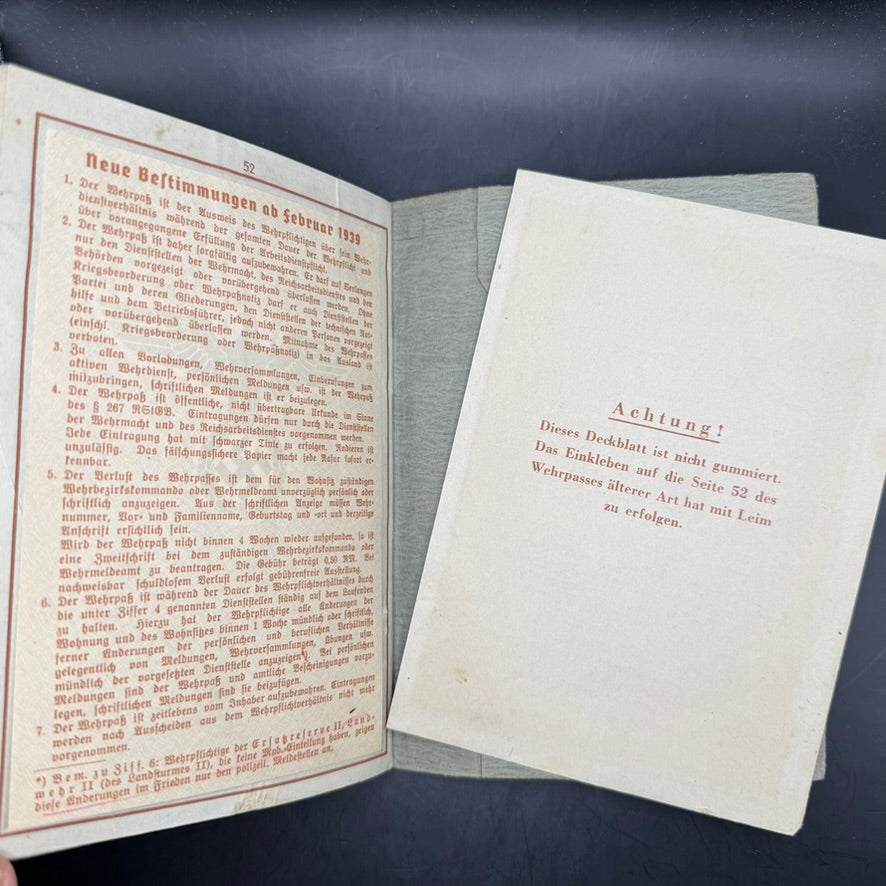
3. Wehrpaß (WWII)
- Original Wehrmacht service booklet
- Correct cover with national eagle
- Name field present (partially filled/issued)
- Represents Heck’s later wartime registration and military status during World War II
Mobilisation and Classification
Heck was officially mustered on 31 July 1940 at the Wehrbezirkskommando Ludwigshafen, where he was classified as dienstpflichtig (liable for service) and assigned to the Landwehr, a reserve category typically used for older soldiers and those designated for rear-area duties. Several subsequent medical and administrative entries confirm that he remained under military authority throughout the war.
Active Service – Bau-Bataillon 159
His active military service began on 27 August 1939, just days before the outbreak of hostilities, and he swore the military oath on 28 August 1939. He was assigned to 5. Kompanie, Bau-Bataillon 159, a construction battalion of the German Army.
Bau-Bataillone were responsible for essential non-combat tasks such as:
- road and bridge construction
- fortifications and defensive works
- airfield and barracks construction
- repair of infrastructure damaged by bombing
- These units were typically staffed by older reservists and specialists, rather than frontline infantry. Heck’s assignment strongly indicates service behind the lines, most likely within Germany or occupied rear areas.
Medical Reclassification and Recovery Unit
During his service, Heck was transferred to a Genesenden-Kompanie (convalescent company), attached to Bau-Ersatz-Bataillon 11. Such units were reserved for soldiers recovering from illness or exhaustion who were temporarily unfit for full duty but still capable of light work.
This transfer suggests that Heck suffered from medical or physical limitations, though not from severe wounds. A medical examination dated 9 May 1940 judged him “gesund und entlassungsfähig” (healthy and fit for discharge).
Discharge from Active Duty
On 9 May 1940, Friedrich Heck was formally released from active military service and classified as Landwehr I, meaning he was no longer required for continuous active duty but remained available for recall if necessary.
Despite this discharge, his documents show that he continued to be administratively monitored and required to report to military authorities throughout the war years.
Reserve Status and Late-War Records
Numerous official stamps and entries document Heck’s continued registration with various Wehrmeldeämter (military registration offices), including entries dated:
- June 1944
- February 1945
- March 1945
-
July 1945, after Germany’s capitulation
These late-war and post-war entries confirm that:
- he survived the war
- he was not missing in action
- there is no indication of captivity
- his military status was formally concluded through administrative channels
Rank and Role
The records indicate a final rank consistent with Obergefreiter-level responsibility, including temporary leadership or supervisory duties within his unit. No frontline decorations or combat awards are listed, further supporting his role as a rear-area, non-combat soldier rather than a frontline combatant.
🔎 Historical Significance
This grouping is especially desirable due to:
- Clear name attribution across all three documents
- Coverage of both WWI and WWII
- Inclusion of an SA Leistungsbuch, which is increasingly scarce with intact pages and stamps
- Strong geographic continuity (Germersheim → Ludwigshafen am Rhein)
- Excellent research potential for collectors and historians
Such complete, multi-period document groupings from a single individual are becoming increasingly difficult to find.